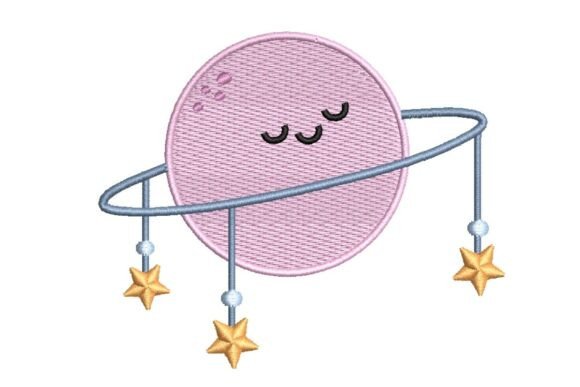
Sweet Sleeping Planet Mobile Embroidery Design
First Impression: Soft Whimsy That Stops Scrollers—and Shoppers
As an embroidery designer who’s prepped over 200 craft fair booths, I’ll say it straight: Sweet Sleeping Planet Mobile Embroidery Design lands with quiet charm—not loud novelty, but gentle magnetism. It reads “soft,” “whimsical,” and “intentionally calm” at a glance. No bold typography, no sharp edges—just a ringed planet with a sleeping face, rendered in textured light pink. That tells me it’s built for the Nursery space, yes—but more importantly, it’s designed to resonate with customers seeking emotional warmth, not just decoration. At a crowded handmade market, where bold florals and witty slogans dominate, this design breathes. It stands out by slowing down.
Where It Shines on Craft Fair Products
This isn’t a one-size-fits-all machine embroidery design—it’s a mood-setter that earns its place selectively. On tote bag design, it works best centered on the lower third of a natural canvas or oat linen tote: large enough to read as intentional art, small enough to leave room for texture and hand-stitched handles. As apron embroidery, it’s ideal on the pocket—small-scale, high-impact, instantly memorable. For tea towel embroidery, avoid dense terry weaves; instead, choose smooth cotton or linen blends where the planet’s subtle texture reads clearly. A single embroidered patch made from this design sells beautifully as a nursery gift add-on—pair it with a wooden rattle or organic swaddle for instant bundle appeal.
It’s less effective on curved surfaces like caps (the sleeping face loses softness when stretched), and risky on heavily textured towels unless stitch density is carefully adjusted. As a pillow cover focal point? Yes—if scaled to 4.5–5 inches wide on a 16” square pillow. As a fabric pouch front panel? Perfect—especially on blush or heather gray twill. And for handmade gifts, it elevates simple items: a tiny embroidered muslin drawstring bag becomes a keepsake when stamped with this design.
Real-World Production Notes Every Embroidery Designer Should Check
Before cutting fabric or loading hoops, run these checks:
- Test the design on scrap fabric matching your final product—especially if using textured linen or brushed cotton.
- Check thread contrast: Light pink planet + pale gold or ivory thread = delicate; swap to charcoal gray thread on dark fabric only if the sleeping face retains clarity.
- Review spacing: Rings around the planet must stay crisp—not crowded by hoop tension or adjacent stitching.
- Confirm hoop size compatibility: If your booth relies on 4x4 hoops, verify the design fits without scaling distortion.
- Inspect stitch density: Dense fill areas near the planet’s rings can cause puckering on lightweight fabrics—light stabilizer may not suffice.
- Use the right stabilizer: Tear-away for smooth cottons; cut-away for knits or stretchy blends used in babywear.
- Create at least one real mockup—not just a printable mockup—before committing to 30 units. See how light hits the texture in person.
- Compare fabric colors: That “textured light pink” shifts dramatically across dye lots—order swatches before bulk purchasing.
- Confirm commercial licensing before selling finished products. This is a digital embroidery file; ensure your license covers resale of physical handmade product.
Photography & Online Appeal for Etsy Sellers and Small Shop Owners
This design photographs exceptionally well—if you shoot it on clean, matte backgrounds with soft directional light. The sleeping face invites close-ups; the rings catch gentle highlights. For Etsy seller listings, pair it with lifestyle shots: a tote bag resting beside a ceramic mug, a patch pinned to a denim jacket sleeve, a pillow nestled in a sunlit corner. Avoid cluttered flat lays—the design’s strength is its quiet focus. As a printable mockup, it translates cleanly into digital assets for social media banners or email headers. Its simplicity makes it highly repeatable for batch production without visual fatigue—a huge win when prepping for a weekend craft fair.
Booth Impact, Brand Consistency, and Buyer Engagement
In my booth, Sweet Sleeping Planet Mobile Embroidery Design anchors a curated “Dream Space” mini-display: embroidered muslin bags, a single pillow cover, and three tea towels folded with ribbon. Customers pause. They touch. They ask, “Is that for babies?” Then they linger—because it feels personal, not mass-produced. It supports brand consistency for makers who lean into gentle, mindful aesthetics—think slow parenting, eco-conscious gifting, or modern heirloom crafting. Unlike trend-driven motifs, this has staying power: it won’t feel dated next season. And because it’s emotionally resonant—not just decorative—it sparks conversation, which directly boosts buyer engagement and average order value.
Careful-Use Reminders for Handmade Market Success
Don’t force it onto every product. Avoid placing it on dark fabric without verifying face detail retention. Skip ultra-small applications (<3 inches wide) unless the file includes optimized small-scale versions—the sleeping eyes and mouth may blur. Steer clear of thick, napped fabrics like fleece or heavy terry unless stitch density is reduced and underlay is increased. And never skip testing on the exact fabric you’ll use for your craft fair product: what looks perfect on screen often needs micro-adjustments in thread tension or jump stitch placement to shine IRL.
Final Verdict: A Thoughtful, Sellable Embroidery File
Sweet Sleeping Planet Mobile Embroidery Design isn’t flashy—but in the handmade economy, thoughtful often outsells flashy. It’s a premium-feeling machine embroidery design that delivers emotional resonance, strong visual cohesion, and reliable production behavior—when respected as a nuanced Embroidery asset, not just another clipart download. For creative entrepreneurs building a distinctive booth presence, it’s not filler. It’s focus. Use it intentionally, test thoroughly, and let its quiet magic do the talking.